
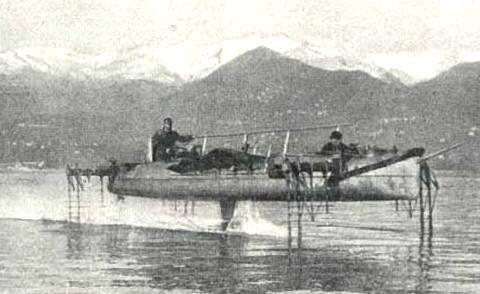
Hydrofoil boat 1910 Forlanini Idroplano - Lake Maggiore
The hydrofoil
The March 1906 Scientific American article by American hydrofoil pioneer William E. Meacham explained the basic principle of hydrofoils. Bell considered the invention of the hydroplane as a very significant achievement. Based on information gained from that article he began to sketch concepts of what is now called a hydrofoil boat.
Bell and Casey Baldwin began hydrofoil experimentation in the summer of 1908 as a possible aid to airplane takeoff from water. Baldwin studied the work of the Italian inventor Enrico Forlanini and began testing models. This led him and Bell to the development of practical hydrofoil watercraft.
During his world tour of 1910–1911 Bell and Baldwin met with Forlanini in Italy. They had rides in the Forlanini hydrofoil boat over Lake Maggiore. Baldwin described it as being as smooth as flying. On returning to Baddeck a number of designs were tried culminating in the HD-4, using Renault engines. A top speed of 54 miles per hour was achieved, with rapid acceleration, good stability and steering, and the ability to take waves without difficulty. Bell's report to the navy permitted him to obtain two 350 horsepower (260 kW) engines in July 1919. On September 9, 1919 the HD-4 set a world's marine speed record of 70.86 miles per hour. This record stood for ten years.
Bell was a supporter of aerospace engineering research through the Aerial Experiment Association, officially formed at Baddeck, Nova Scotia in October 1907 at the suggestion of Mrs. Mabel Bell and with her financial support. It was headed by the inventor himself. The founding members were four young men, American Glenn H. Curtiss, a motorcycle manufacturer who would later be awarded the Scientific American Trophy for the first official one-kilometre flight in the Western hemisphere and later be world-renowned as an airplane manufacturer; Frederick W. "Casey" Baldwin, the first Canadian and first British subject to pilot a public flight in Hammondsport, New York; J.A.D. McCurdy; and Lieutenant Thomas Selfridge, an official observer from the U.S. government. One of the project's inventions, the aileron, is a standard component of aircraft today. (The aileron was also invented independently by Robert Esnault-Pelterie.)
Eugenics
Along with many very prominent thinkers and scientists of the time, Bell was connected with the eugenics movement in the United States. From 1912 until 1918 he was the chairman of the board of scientific advisors to the Eugenics Record Office associated with Cold Spring Harbor Laboratory in New York, and regularly attended meetings. In 1921 he was the honorary president of the Second International Congress of Eugenics held under the auspices of the American Museum of Natural History in New York. Organizations such as these advocated passing laws (with success in some states) that established the compulsory sterilization of people deemed to be, as Bell called them, a "defective variety of the human race." By the late 1930s about half the states in the US had eugenics laws, the California laws being used as a model for eugenics laws in Nazi Germany.
Much of his thoughts about people he considered defective centered on the deaf because of his long contact with them in relation to his work in deaf education. In addition to advocating sterilization of the deaf, Bell wished to prohibit deaf teachers from being allowed to teach in schools for the deaf, he worked to outlaw the marriage of deaf individuals to one another, and he was an ardent supporter of oralism over manualism. His avowed goal was to eradicate the language and culture of the deaf so as to force them to integrate into the hearing culture for their own long-term benefit and for the benefit of society at large. Although this attitude is widely seen as paternalistic and arrogant today, it was mainstream in that era.
Although he supported what many would consider harsh and inhumane policies today, he was not unkind to deaf individuals who proved his theories of oralism. He was a personal and longtime friend of Helen Keller, and his wife Mabel was deaf, though none of their children were. Bell was well known as a kindly father and loving family man who took great pleasure in playing with his many grandchildren.
His son-in-law was National Geographic Editor Gilbert Hovey Grosvenor.
Tribute
In the early 1970s, UK Rock Group The Sweet recorded a tribute to Bell and the telephone, suitably titled "Alexander Graham Bell". The song gives a fictional account of the invention, in which Bell devises the telephone so he can talk to his girlfriend who lives on the other side of the United States. The song reached the top 40 in the UK and went on to sell over one million recordings world-wide.
Another musical tribute to Bell was written by the British songwriter and guitarist Richard Thompson. The chorus of Thompson's song reminds the listener that "of course there was the telephone, he'd be famous for that alone, but there's fifty other things as well from Alexander Graham Bell". The song mentions Bell's work with discs rather than cylinders, the hydrofoil, Bell's work with the deaf, his invention of the respirator and several other of Bell's achievements.
source:http://www.solarnavigator.net/inventors/alexander_graham_bell.htm

Walang komento:
Mag-post ng isang Komento